
Gen Pande also said that Indian troops are adequately deployed along the Line of Actual Control to deal with any situation and that guidance has been given to them to "remain firm and resolute" in their tasks.

The talks between India and China on the border row in eastern Ladakh have helped 'build trust' and the situation in the region has been normal since the disengagement in the Pangong Tso areas in February, Chief of Army Staff General M M Naravane said on Thursday, exuding confidence of resolution of the 'remaining issues'.

The government must figure out what the Chinese game plan is and thwart the endgame before it is upon us, possibly in early winter, advises David Devadas.

Congress as the opposition party has become increasingly aggressive against the Narendra Modi government over its handling of the border standoff with China.
The talks till now have resulted in the resolution of issues in North and South Bank of Pangong Tso, Galwan and Gogra Hot Spring areas.
"I still have not heard a credible explanation as to why they chose to bring that size of forces to that sector of our border. Now, if peace and tranquility is disturbed and attempts are being made to change the LAC status quo unilaterally and large forces are brought to the border in contravention of written agreements, then obviously the relationship will be impacted," he said.

Member of Parliament from Arunachal Pradesh Tapir Gao said on Wednesday that a teenager, identified as Miram Taron, was abducted by the People's Liberation Army from Lungta Jor area under Siyungla area on Tuesday.
Singh also said that India will give a befitting reply to anyone threatening its unity, sovereignty and territorial integrity as it no longer remained a "weak" country.

There is a possibility of more talks at the military and diplomatic levels. India has always been in favour of peace. So, we hope a solution will be found out through talks, Singh said
During their hour-long in-person meeting on the sidelines of a Shanghai Cooperation Organisation (SCO) conclave in Dushanbe on Wednesday, External Affairs Minister S Jaishankar also told his Chinese counterpart and State Councilor Wang Yi that any unilateral change in the status quo along the Line of Actual Control (LAC) was 'not acceptable' to India and that the overall ties can only develop after full restoration of peace and tranquillity in eastern Ladakh.

Under the India-China agreement on the disengagement process in eastern Ladakh, the Chinese army will pull back its troops to east of Finger 8 areas in the northern bank of Pangong lake, Defence Minister Rajnath Singh said in Parliament on Thursday, in what is seen as a significant step to dial down tensions in the key face-off site.

On May 5, around 250 Indian and Chinese army personnel clashed with iron rods, sticks, and even resorted to stone-pelting in Pangong Tso lake area in Eastern Ladakh.

'The numbers of troops on both sides are enormous.' 'They are about 50,000-60,000 soldiers facing each other in that sector -- that's about the total number of troops that both sides had in the 1962 War in all sectors.'

'(The) PM has surrendered Indian territory to Chinese aggression. If the land was Chinese: Why were our soldiers killed? Where were they killed,' he asked on Twitter, tagging the prime minister's remark.

'China is unwilling to restore the status quo ante of April 2020.' 'India will have to weigh its options based on this premise.'

After a gap of over two-and-half months, India and China on Sunday held the ninth round of military talks specifically focusing on ways to move forward on the long-negotiated disengagement process in eastern Ladakh as thousands of their troops remained deployed at friction points under freezing conditions.

"All temporary structures and other allied infrastructure created in the area by both sides have been dismantled and mutually verified. The landform in the area has been restored by both sides to the pre-standoff period," the Army said in a statement.
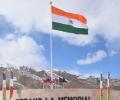
Visiting the Rezang La Memorial, one has a feeling of super-humans defending the Indian territory against the Chinese onslaught, says Claude Arpi on the 60th anniversary of the heroic battle of the 1962 War.

Singh said if there is an attempt to hurt the self-respect of India, then it will not be tolerated and will be given a 'befitting reply'. "Whatever progress has been made in the talks, there should be a resolution of the matter. But to what extent it will be resolved, I cannot guarantee."

Members of the Congress also walked out of the Lok Sabha and staged a sit-in in the Parliament House complex after they were not allowed to speak following a statement by Defence Minister Rajnath Singh on the border standoff with China in eastern Ladakh.
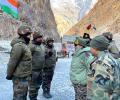
'We hope this round of meeting, on the basis of previous meetings, can move forward, further enlarge consensus, narrow differences and work for a solution that is acceptable to both parties,' the spokesperson said in updated comments posted on the ministry's website.

'If our troops on the frontlines were sleeping for two hours, they can perhaps now sleep for 2.5 hours because when the adversary is right in front, then you can't even blink your eyes, you have to be absolutely alert.'
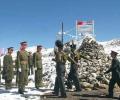
'We will not accept these misadventures by the Chinese.'
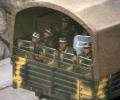
The intrusions into India were likely carried out by the PLA's better trained and equipped 'mobile operational units'.

Rediff reader CK Varma shared these photographs.
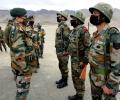
'India is not the India of 1962. We are not carrying that baggage of history anymore.'

Gen Naravane said that the Indian Army did not hide casualties during Galwan clash in eastern Ladakh as the Chinse have done.
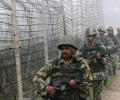
Most of India's reserves for war in the mountains have been sucked in by the standoff with China. A large part of India's airpower has also similarly been committed on the eastern border. By moving these reserves to the China border, India has been weakened vis-a-vis Pakistan. All in all, the nightmare scenario for India of a two-front war may well come true, warns Colonel Anil A Athale (retd).

The ministry's year-end review is silent on the continued occupation by Chinese troops of territory that India has always claimed and patrolled.
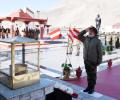
Lieutenant General Harinder Singh, who commands the 'Fire and Fury' 14 Corps, has the experience and talent to face down the Chinese challenge. The general is a rare combination of thinker and tough-minded doer, observes David Devadas.

This is the first time Pakistan and Kashmir have been brought into the narrative.
Talking about dealing with the border issue faced by India, Jaishankar, without naming any country or going into details, said, "You know again we did what we had to do. There was a very active debate which still continues to this day. It is natural for people to offer advice, often on matters which they may not have particular knowledge of, that are a human trait. But again if there was what came through it was that we were resolute, we were strong about protecting our interests."
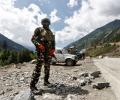
'How Xi Jinping will withdraw the aggression and justify it to his Communist party in case of a negotiated settlement might be his biggest headache.' 'Unless he is ready to gamble on an armed conflict, whose outcome given India's battle-readiness and determination is always uncertain,' observes Virendra Kapoor.
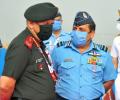
Gen Rawat's comments about the supporting role of the Air Force came at a conference when asked about the growing perception that the Indian Air Force was not keen on setting up the proposed theatre commands integrating the capabilities of the three forces.

China has chosen to keep New Delhi guessing, while retaining for itself the option of constantly changing facts on the ground and shifting the LAC westwards -- the strategy called 'salami slicing', notes Ajai Shukla.
The sources said both sides held extensive deliberations on modalities for disengagement of troops from all the friction points in eastern Ladakh at the talks.

'There is a point near the hill where you kill the engine and park your vehicle in neutral.' 'The vehicle automatically slides a few inches, which the locals believe is due to the magnetic power of the hill.'

'We must acknowledge China will use Pakistan against India.' 'We all need to know that these two countries are ready to destabilise India at all times.'

Through the past 18-month period, peace has prevailed in the disputed border regions, which was immensely helpful in the difficult situation that the country was passing through, observes Ambassador M K Bhadrakumar.

General Zhao Zongqi is well known in India for having commanded the Chinese troops during the Dokalam episode. Zhao knows every inch and corner of the Indian border, at least the Eastern and Central sectors, including the Naku La area which witnessed fist-fights between Indian and Chinese troops in April/May. Claude Arpi introduces us to the PLA generals masterminding the Chinese aggression in Ladakh.
